
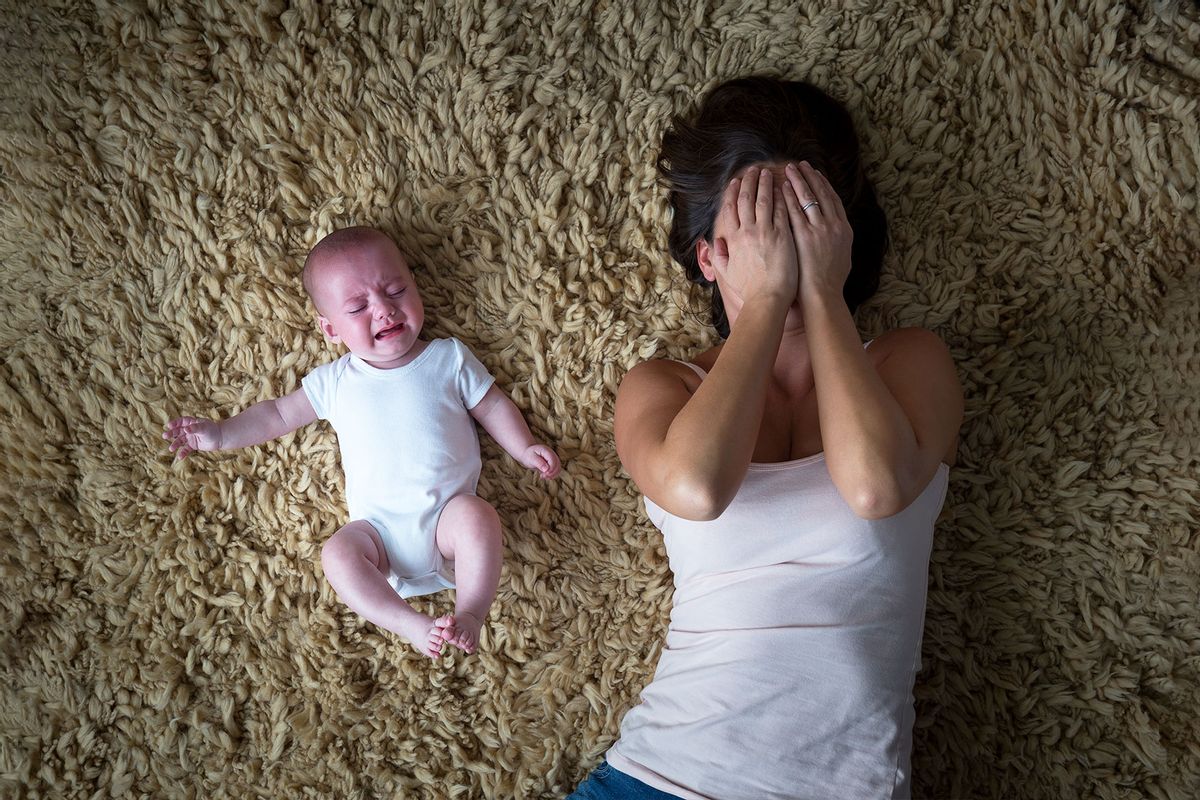
Watch your voice, moms. A new study from Germany reports a link between a mother’s postpartum blues and developmental delays in infants.
But while the volatile effects of parental mental health on children and the need for enhanced resources for families are real and pressing issues, the framework around these issues reveals other things that may need some improvement.
“Communicating with infants in infant speech is considered an important prerequisite for the successful language development of little ones,” says the Max Planck Institute for Human Cognitive and Brain Sciences in a statement about the study. But a summary with the words “success” and “baby” in the same sentence immediately raises a few questions. The research itself is of interest, focusing on a small sample of 46 mothers and their infants and the correlation between mothers’ moods and infants’ early language development.
The findings revealed that “even children whose mothers suffer from mild depressed mood and do not yet need medical treatment show early signs of delayed language development.” Or, as one CNBC headline largely put it, “Mother’s mood can affect a child’s ability to speak, the study reveals.”
A mother’s voice has an undeniable influence. A child will begin to recognize it in the womb before learning the voices of other family members. In early infancy, he will prefer this voice to other feminine voices. And babies also prefer higher-pitched, universal singing, which researchers call “mother,” as anyone who’s ever found themselves in someone’s presence knows. We instinctively go to the rhythmic, soothing way of talking to babies because that’s how they begin to grasp language best.
Want more health and science stories in your inbox? Subscribe to Salon’s weekly newsletter, The Vulgar Scientist.
The CDC estimates that roughly one in eight mothers experience postpartum depression. The number of mothers experiencing postpartum mood disorder may be as high as 70 percent. And any mother faced with postpartum depression, or even light baby blues, may find it difficult to change her speech, leaning towards lower, flatter tones that are often a dead-end result of mood disorders. The mother may also be less involved and interactive overall.
Scientists at the Max Planck Institute found that “if mothers show a more negative mood two months after birth, their children show less mature processing of speech sounds at the age of six months on average,” and this could potentially lead to a higher risk. A child who has a speech disorder as he grows up. This is understandably a sincere concern.
However, it’s important to emphasize to moms trying to keep a screaming little meatball alive and feeling unwell today that your child’s speech disorder “pity” doesn’t automatically follow because of your mood swings.
Perhaps more disturbing here is the implication that women’s legitimate physical and emotional needs are of greater concern if it means that someone won’t be accepted into the Harvard class of 2044. Of course, there’s nothing wrong with describing the mental health challenges new moms face. or potential long-term effects on their offspring.
“Women are especially good at taking responsibility for everything that goes wrong in their children’s lives.”
But the dire results of such studies, based on six-month-old babies and without comprehensive long-term data, put even more pressure on a population that is extremely vulnerable to guilt and shame.
As University of Canterbury researcher and clinical psychologist Lisa Marie Emerson told the Washington Post in 2021, “Women are particularly good at getting praise for everything wrong with their children’s lives, partly because of the tremendous social commitment to raising children often ‘right’. It’s pressure. It falls on mothers, not fathers.” And there it is.
We don’t parent in a vacuum. Our children may first know their birth mother’s voice, but they are not the only ones they hear. They are met in a noisy world where no single person should be entirely responsible for their “success” or “suffering”. Gesa Schaad, lead author of the Planck Institute study, said in a recent statement, “To ensure the proper development of young children, appropriate support is also needed for mothers who suffer from mild ailments that often do not yet require treatment.” Said. “Sometimes dads need to be more involved.” don’t you say?
Read more
about modern motherhood