
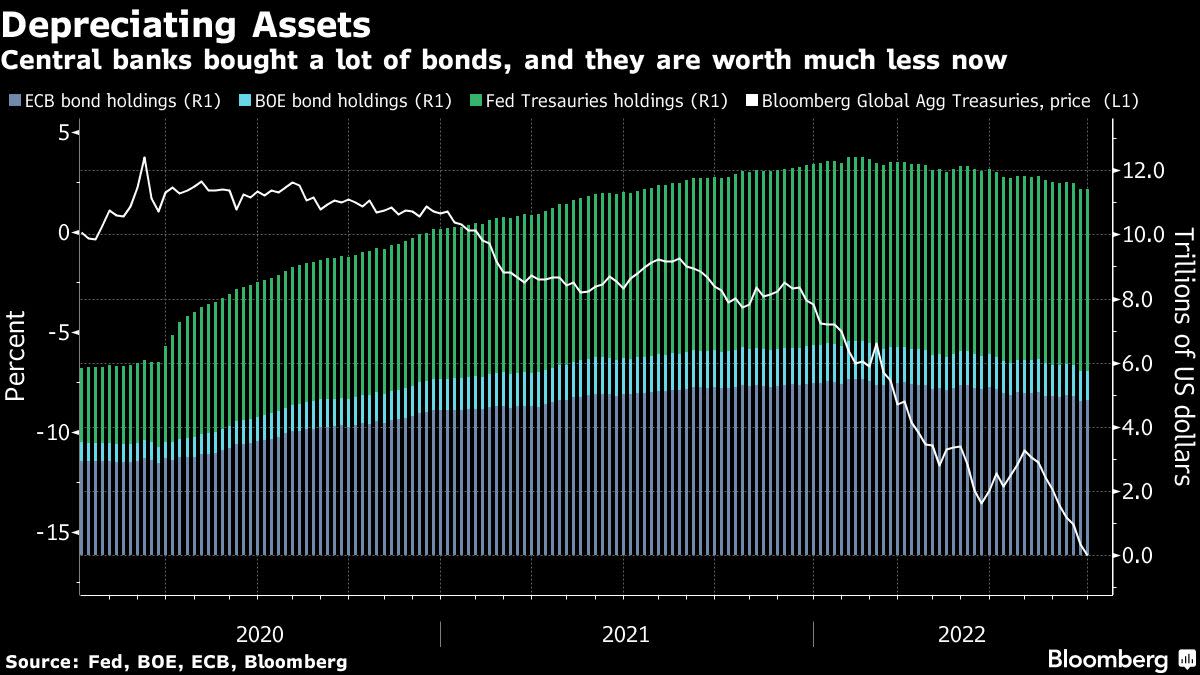
(Bloomberg) — Profits and losses aren’t usually considered an appraisal for central banks, but the skyrocketing red ink and many precedents in the Federal Reserve risk becoming more than just an accounting quirk.
Most Read from Bloomberg
The bond market is experiencing its worst sell-off in a generation triggered by high inflation and aggressive interest rate hikes by central banks. Falling bond prices, in turn, mean paper losses on large holdings that the Fed and others have accumulated during bailout efforts in recent years.
Rate hikes also involve central banks paying more interest on reserves that commercial banks park in them. This pushed the Fed into operating losses, ultimately creating a vacuum that the Treasury Department might have to fill through debt sales. The British Treasury is already preparing to recoup a loss at the Bank of England.
This move by the UK highlights a dramatic shift in countries, including the US, where central banks no longer contribute significantly to government revenues. According to Amherst Pierpont Securities LLC, the U.S. Treasury will see “dramatic fluctuations” from receiving nearly $100 billion from the Fed last year to a potential annual loss rate of $80 billion by year’s end.
Accounting losses threaten to fuel criticism of the asset-buying programs undertaken to bail out markets and economies, most recently when Covid-19 shut down large parts of the global economy in 2020. It may limit the independence of monetary policy makers or the steps they can take in the next crisis.
“The problem with central bank losses is not losses per se – they can always be recapitalized – but central banks are likely to face political backlash,” said Jerome Haegeli, chief economist at Swiss Re. The central bank.
The following figures show the extent of currently realized operating losses or valuation-to-market losses:
-
Fed remittances owed to the U.S. Treasury reached minus $5.3 billion as of October 19 – in sharp contrast to the positive numbers seen at the end of August. A negative number means a debenture that will be repaid through any future income.
-
The Reserve Bank of Australia posted an accounting loss of A$36.7 billion ($23 billion) in the 12 months to June, leaving it in a negative equity position of A$12.4 billion.
-
Dutch central bank Governor Klaas Knot warned last month that he expects cumulative losses of around 9 billion euros ($8.8 billion) in the coming years.
-
The Swiss National Bank reported a loss of 95.2 billion francs ($95 billion) in the first six months of the year as the value of its foreign currency holdings fell – its worst halftime performance since it was founded in 1907.
For a developing country, central bank losses can undermine confidence and contribute to an overall capital outflow, while such a credibility issue is unlikely for a wealthy country.
As Seth Carpenter, global chief economist at Morgan Stanley and a former US Treasury official, put it: “Losses do not have a significant impact on their ability to conduct monetary policy in the near-term.”
RBA Vice-President Michele Bullock said last month, in response to a question about the Australian central bank’s negative equity position, “we do not believe we have been affected in any way in our operating capacity.” After all, “we can create money. That’s what we did when we bought the bonds,” she said.
But it can still have consequences. Central banks, by their own admission, had already become politically charged institutions after failing to anticipate and act quickly against rising inflation over the past year or more. The losses incurred add another magnet for criticism.
ECB Effects
For the European Central Bank, the potential for increased losses comes after years of government bond purchases, despite conservative officials claiming they are blurring the lines between monetary and fiscal policy.
With inflation at five times the ECB’s target, pressure is mounting to divest bond holdings – a process called quantitative tightening that the ECB is already preparing for even as the economic outlook darkens.
Goldman Sachs Group Inc. “While there are no clear economic constraints for the central bank to make a loss, there is a possibility that these will become more of a political constraint on the ECB,” said economists George Cole and Simon Freycenet. It could “encourage the quantitative tightening debate”, especially in northern Europe.
President Christine Lagarde gave no indication that the ECB’s QT decision would likely be harmed. He told lawmakers in Brussels last month that making profits is not part of central banks’ mandate and insisted that fighting inflation is the “sole aim” of policymakers.
As for the Fed, Republicans have in the past opposed paying interest on excess bank reserves. Congress gave this authority back in 2008 to help the Fed control interest rates. With the Fed now at losses and Republicans potentially taking control of at least one chamber of Congress in the November midterm elections, the debate may resurface.
The Fed’s reversal could be particularly noteworthy. After paying up to $100 billion to the Treasury in 2021, policymakers could face losses of more than $80 billion annually if they raise rates by 75 basis points in November and 50 basis points in December, as markets predicted. Stephen Stanley, chief economist at Amherst Pierpont.
Without revenue from the Fed, the Treasury would have to sell more debt to the public to finance government spending.
“This may be too mysterious to hit the public’s radar, but a populist could spin the story in a way that doesn’t reflect the Fed well,” Stanley said in a note to clients this month.
–With the help of Garfield Reynolds.
Top Read from Bloomberg Businessweek
©2022 Bloomberg LP