

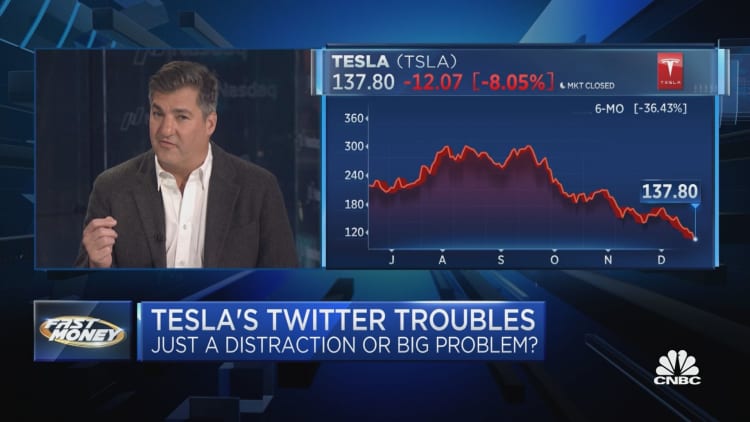
Shares in electric vehicle maker tesla it fell to a new 52-week low on Tuesday to close around $138 a share, or 8% lower for the day on a mixed day for equities.
CEO Elon Musk tried to blame the price drop in part on macroeconomic factors.
investment related news

Longtime Tesla bull Ross Gerber wrote in a tweet, “Tesla’s stock price now reflects the value of not having a CEO. Great job tesla BOD – Time to shake it up. $tsla.” Gerber launched an informal campaign for other shareholders to vote to nominate him to Tesla’s board of directors.
Musk replied, in a tweet“As interest rates on bank savings accounts, which are secured, begin to approach stock market returns, which are unsecured, people will increasingly shift their money from stocks to cash, making cause stocks to fall.”
Elon Musk speaks during a press conference at SpaceX’s Starbase facility near Boca Chica Village in south Texas on Feb. 10, 2022.
James Watson | AFP | Getty Images
But Tesla shares have fallen more than other major automakers since Musk announced his plans to buy Twitter in April 2022. Since that date, Tesla shares have fallen 59%, versus 26% for ford and 12% for GM🇧🇷 The S&P 500 is down 14%.
The Tesla boss has plenty of distractions, as Gerber notes: Musk has been controversial as the new owner and CEO of Twitter, the social media giant he acquired in a leveraged buyout in late October, and is also the CEO of a large defense contractor, SpaceX.
Musk sold billions of dollars of his Tesla holdings to fund the Twitter deal, including a $3.6 billion sale earlier this month.
He told Twitter employees that he sold Tesla stock to “save” its business, while cutting more than half of the company’s staff and implementing a series of policy changes, some of which he later reversed.
While Musk has been focused on his new role as “Chief Twit” since late October, Tesla has been offering discounts and incentives to sell cars in China, where it operates a large factory in Shanghai; struggling to make its new factories in Austin, Texas and Brandenburg, Germany efficient; and facing persistent supply chain challenges endemic to the auto industry, along with rising energy prices in Europe, which could reduce the appeal of a battery electric vehicle for many drivers.
Those, among other challenges, prompted Mizuho Securities and Evercore ISI to lower their Tesla price targets on Tuesday.
Analysts at Mizuho Securities wrote in a note that “in the near term, we see potential weakness in Tesla sales as macro headwinds and a weaker consumer could lead to lower demand for higher priced EVs.” The company is still bullish on Tesla for the long term, citing the company’s new factories as a competitive advantage and new tax credits for electric vehicles on the horizon in the US, which could “accelerate demand” domestically. In China, some EV credits expire in early 2023. The company has a $285 price target and a Tesla Stock Buy rating.
An assistant professor at Vanderbilt University, Joshua White, who previously worked as an economist for the US Securities and Exchange Commission, told CNBC: 🇧🇷Only part of Tesla’s drop in value can be attributed to interest rates. Twitter overhead is an important component. China is another big component. We still don’t know if China will be fully open and we see that there is supply and demand pressure here due to the increase in covid cases and disruptions.”
He also said Elon Musk may have lost shareholder confidence when he said in April that he didn’t plan to sell more of his Tesla shares, but went ahead and sold billions of dollars more.
“He seems to sell shares in really big chunks, say ‘I’m done and I’m not selling anymore.’ But talking is easy. He says so and then sells more shares. So the more you say that and investors think he probably didn’t do that? The less confident they will be that the price will recover.”
🇧🇷