
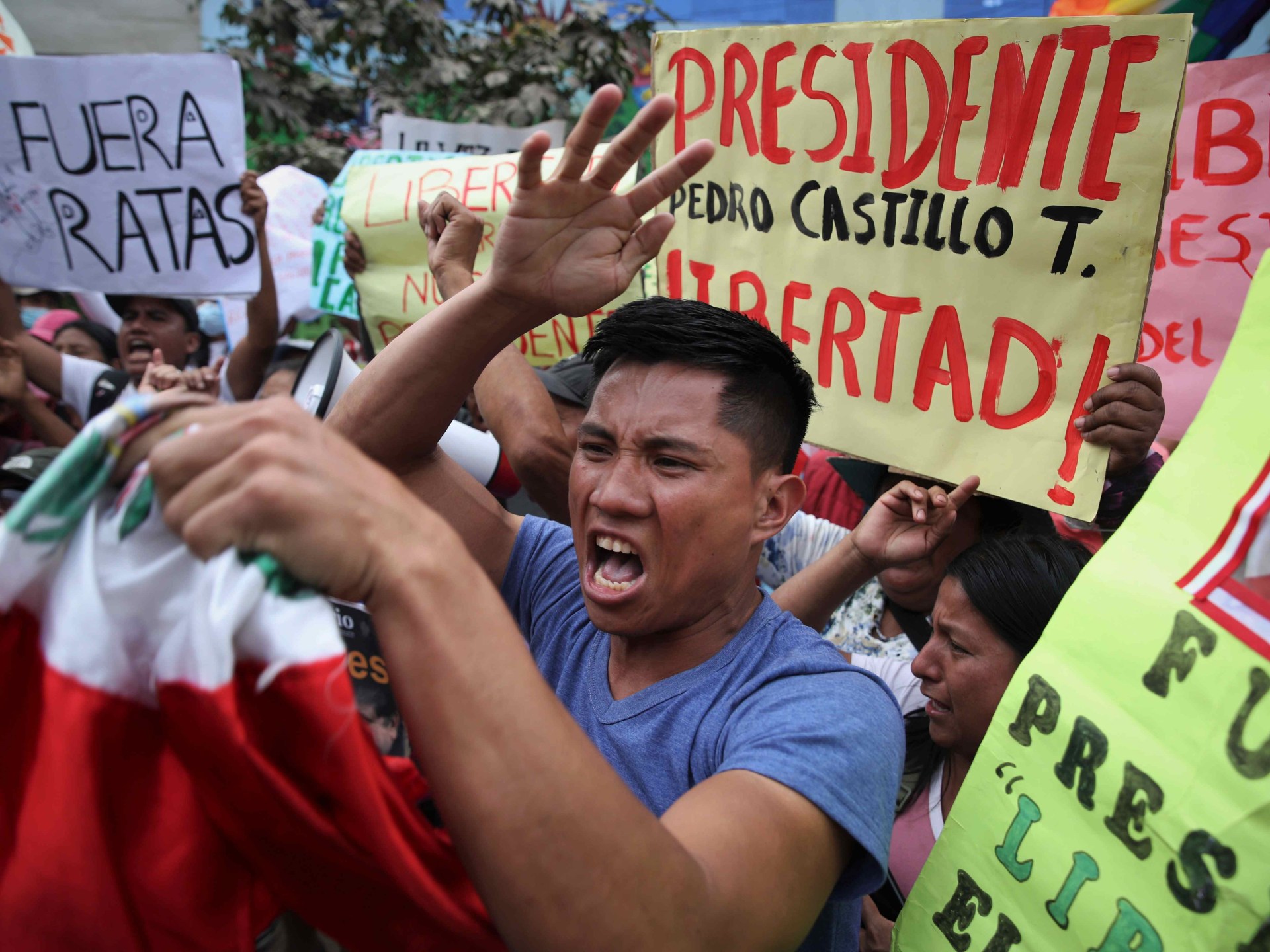
Former President Pedro Castillo is asking his supporters to go to prison, where he is being held while prosecutors are asking for an 18-month detention.
Peru has declared a nationwide state of emergency amid a week of protests and political unrest following the ousting and arrest of former President Pedro Castillo.
Peruvian Defense Minister Alberto Otarola announced the new 30-day measure, which he said involved “the suspension of freedom of movement and assembly” and could include a curfew, on Wednesday due to “acts of vandalism and violence,” including roadblocks.
“The National Police, with the support of the Armed Forces, will ensure control throughout the national territory of personal property and, above all, of strategic infrastructure and the safety and well-being of all Peruvians,” said the minister.
The move came as a judge ordered Castillo to remain in prison on charges of “rebellion” and “conspiracy” for an additional 48 hours before a release hearing.
Castillo supporters took to the streets across the South American country to demand the leftist leader’s release, as well as new elections and the ousting of his successor, former vice president Dina Boluarte.
The crisis began last week, when Castillo, a former rural teacher and union leader who took office in July last year, announced plans to dissolve Peru’s Congress and rule by decree.
The measure was widely denounced as unconstitutional and prompted the opposition-led legislature last Wednesday to vote overwhelmingly in favor of removing him in the third attempt to impeach his embattled presidency.

Boluarte was sworn in shortly afterwards as Peru’s first female president, and Castillo was arrested and transferred to a police prison near the capital, Lima, where he is still being held.
Peruvian prosecutors said this week they are asking for 18 months of pretrial detention for Castillo, who has rejected the charges against him and said he is being “unjustly and arbitrarily detained”.
Peru’s Supreme Court met to consider the prosecution’s request on Wednesday, but later adjourned the session until Thursday.
Castillo urged supporters to appear on Wednesday afternoon at the police facility where he is being held, arguing that he should be released after an initial period of seven days of preliminary detention that expires at the end of the day.
He also urged the Inter-American Court of Human Rights to intercede on his behalf.
“Enough is enough! The outrage, humiliation and mistreatment continue. Today they restrict my freedom again with 18 months of preventive detention”, he wrote in a message posted on Twitter. “I hold judges and prosecutors responsible for what happens in the country. ”
The Peruvian Ombudsman reduced the death toll from the demonstrations to six on Tuesday. Protests were particularly prominent in rural areas of the country, where Castillo’s political support is strongest.

Boluarte, the new president, tried to quell the unrest by promising to hold early elections rather than ending the remaining three-and-a-half years of Castillo’s term – a key demand of protesters last week.
On Wednesday, she again said the elections could be brought forward, this time to December 2023. “Legally, it works for April 2024, but by making some adjustments we can bring them forward to December 2023,” she told reporters. .
Boluarte also reiterated a call for calm in the streets. “We cannot dialogue if there is violence between us,” she said from the presidential palace.
But observers raised concerns about the deteriorating situation as the protests continued.
Peru’s chief ombudsman, Eliana Revollar, told the AFP news agency on Tuesday that things could get worse. “This is a very serious social upheaval,” said Revollar.
“We fear that this will lead to an uprising because there are people who call for an insurrection, who ask to take up arms.”
🇧🇷