
CNN
🇧🇷
A week after assuming the presidency, Peru’s new president, Dina Boluarte, is struggling to contain the widespread protests that erupted after the overthrow of former president Pedro Castillo. She is the country’s sixth president in less than five years.
Boluarte announced on Tuesday that the government will create a crisis management committee, as protests calling for policy changes continue across the country. The committee will be led by Pedro Angulo, president of the Council of Ministers of Peru, and will include other representatives, including the heads of the ministries of defense, transport, interior and communications, among others, the presidency announced on Twitter on Tuesday.
Castillo has denied the conspiracy and rebellion charges, following his impeachment and arrest last week.
The former president was arrested last week. His seven-day pre-trial detention order was due to end at 1:42 pm ET on Wednesday. In a handwritten letter posted to Twitter, Castillo called on supporters to gather now at the Lima detention center where he is being held.
However, a hearing to determine whether Castillo’s detention will be extended has been postponed to Thursday morning, Judge Juan Carlos Checkley said in a virtual courtroom session on Wednesday. Checkley said Castillo will remain in detention until then.
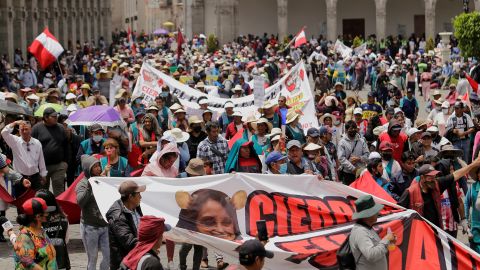
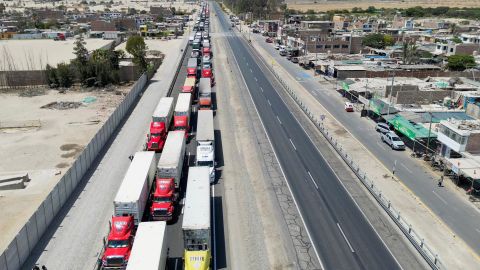
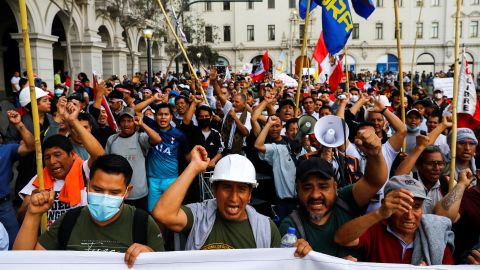
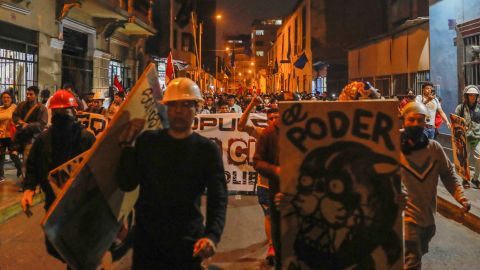
Castillo supporters have been protesting since his arrest and impeachment last week. As of Tuesday night, national roads in at least 14 regions of the country were blocked by protests, Peru’s National Police said in a statement.
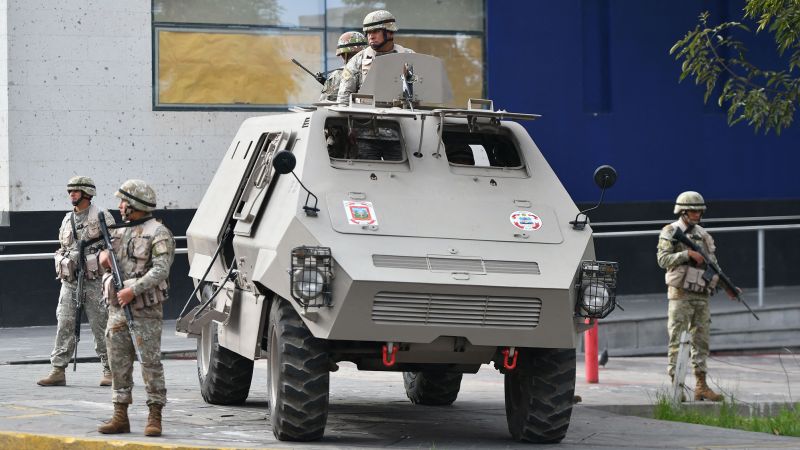
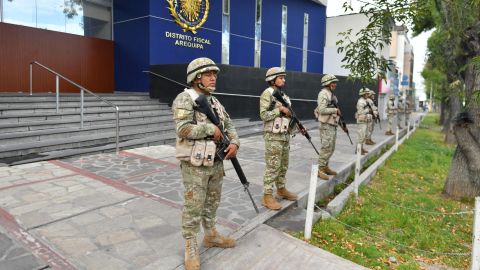
The army has been deployed in Peru to protect public spaces across the country amid ongoing protests, according to a statement from Peruvian Defense Minister Luis Alberto Otárola late on Tuesday.
“The Armed Forces ordered the immediate protection of strategic points of national assets, airports, hydroelectric plants and all that infrastructure that, due to its strategic value, serves to guarantee the life and subsistence of all Peruvians”, explained Otárola. in a statement carried by Peru’s state media, Peru TV.
The Minister of Defense also declared a state of emergency for the national road network.
“We are going to take control of the national road network throughout the country, to guarantee free transit for all Peruvians,” said Otárola.
He also said that a state of emergency was specifically implemented in the southern cities of Arequipa and Ica, “so that the Armed Forces and the National Police can take control of the internal order”.
What triggered the recent unrest in Peru?
Peru was plunged into further political turmoil when Castillo was impeached and arrested on Dec. 7 after announcing plans to dissolve Congress and install an emergency government ahead of an impending impeachment vote by lawmakers.
Boluarte, his former vice president, has since become president and on Monday proposed bringing the general election forward by two years to April 2024 during a televised speech.
Castillo’s removal from power accelerated long-standing political tensions in the country. Since last week, demonstrations have erupted in cities across the country, sometimes marked by clashes with Peruvian security forces. Some are protesting in support of Castillo, while others want a total reboot of the country with new general elections and the dissolution of Congress.
Who is Pedro Castillo?
Elected in July 2021 by a narrow margin in a run-off, the former leftist leader has vowed to “govern with the people and for the people”, but his short-lived presidency has mostly focused on his own political survival.
A former rural school teacher, Castillo survived two impeachment attempts in his first year as president and faces six ongoing investigations by the National Attorney’s Office.
His government has been mired in chaos since taking office, with dozens of ministers appointed, replaced, fired or resigned in just over a year – further adding to the pressure on the embattled president ahead of his ouster last week.
Castillo has criticized the opposition for trying to oust him from the first day he took office and accused Peru’s attorney general, Patricia Benavides, of orchestrating what he called a new form of “coup d’état” against him.
In October, Benavides filed a constitutional lawsuit against him based on three of the six investigations his office opened. The complaint allowed Congress to carry out its own investigation against the former president.
The national prosecution investigated a series of investigations into whether Castillo used his position to benefit himself, his family and closest allies by selling influence to obtain favors or preferential treatment, among other allegations.
Castillo has repeatedly denied all allegations and reiterated his willingness to cooperate with any investigation. He argues that the allegations are the result of a witch hunt against him and his family by groups that did not accept his election victory.
Are the protests violent?
At least seven people have died in Peru’s ongoing protests, according to a health ministry tweet on Wednesday.
Two minors were among the dead, the Peruvian ombudsman’s press office said on Tuesday. And at least 47 people have been hospitalized as a result of protests in the cities of Lima, Apurímac, Huancavelica and Arequipa, the Peruvian Ministry of Health tweeted.
Boluarte called on Tuesday for calm to be restored to the country and said he had instructed police not to use lethal weapons against protesters.
“Everyone has the right to protest, but not to vandalize, burn hospitals, ambulances, police stations, rob airports, (these) are not normal protests, we have reached the extreme”, added Boluarte.
What other disturbance did the unrest cause?
Trails and air travel in some regions of Peru have been affected by the demonstrations. Trains to and from Machu Picchu were suspended from Tuesday, rail operator PeruRail said in a statement.
“We regret the inconvenience these advertisements cause our passengers; however, they result from situations beyond the control of our company and seek to prioritize the safety of passengers and workers”, says the statement.
Flights were also disrupted due to protests, with LATAM Airlines Peru announcing the temporary suspension of services to and from airports in the cities of Arequipa and Cuzco.
Protesters tried to storm the terminal at Alejandro Velasco Astete International Airport in Cuzco on Monday, according to the Peruvian Corporation of Airports and Commercial Aviation (CORPAC).
So far, there have been no reports of injuries, arrests or damage to the airport, according to CORPAC.
What do the protesters want?
Protesters called for a general election, the dissolution of Congress and the creation of a new constituent assembly.
Fernando Tuesta Soldevilla, professor of political science at the Pontifical Catholic University of Peru (PUCP), told CNN that the protests represented a violent display of anger against “everything that has accumulated in recent years: growing social and economic disruptions.”
He added that the protesters were also demonstrating for social and environmental issues, in addition to their “angry rejection of Congress”.
However, Peruvian legislators hold the key to calling new elections and are unlikely to do so, as they would be losing their jobs, according to Tuesta Soldevilla.
Will Boluarte’s ascendancy bring stability?
Peru has been plagued by political instability in recent years, with many Peruvians calling for policy changes, according to a September poll by the Instituto de Estudios Peruanos, which found that 60% of respondents supported early elections to renew the presidency and Congress.
It is unclear whether Boluarte’s ascension to the presidency can gain wide political acceptance.
Boluarte “does not have a recognized political career,” said Tuesta Soldevilla. “And without partisan support, political party or social organization behind it, it is weak from the start.”
“Everybody knows when Dina Boluarte’s government began, but nobody knows for sure how long it will last,” he told CNN.
Boluarte also does not belong to any political party after being expelled from Peru Libre due to internal disagreements. She would need to build bridges and get some consensus with the opposition in Congress to stay in office.
🇧🇷