
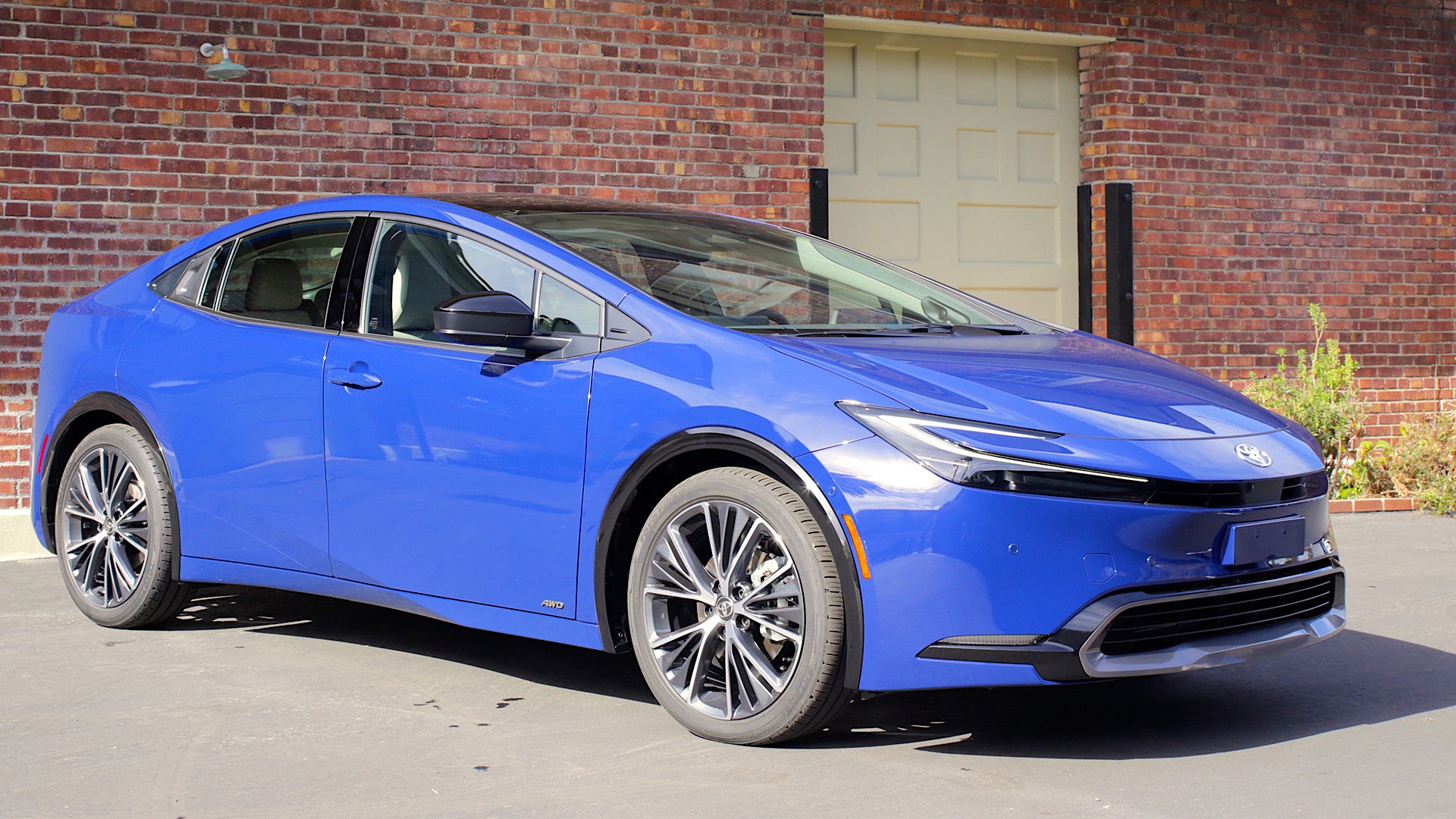
Few badges carry more canon than the Toyota Prius. Since its debut in North American showrooms in the year 2000, it has received so much love, but also so much hate. If you’re the type of person who spends your days perusing sites like this one, you’ll mostly remember the hate. We don’t need to paint a picture – a quick browse of social media will tell you all you need to know about the reputation of this long-standing Toyota badge. But the all-new, fifth-generation 2023 Toyota Prius might have the ability to change some of that.
When we first served our audience an amuse-bouche of this on Instagram, few cars before have received such a shocked reaction, a feeling that carries over into the physical realm. Every person I told that I was going to San Diego County to drive the new Prius gave me some version of “Wow, let me know how it goes” and “I never thought I’d be excited about a new Prius!”
But do the car’s features, new technology and driving experience fit the hype? After driving a front-wheel-drive mid-level XLE trim as well as an all-wheel-drive XLE, things are looking up.
This new 2023 model represents a big change for the Prius. It no longer looks like a piece of fake Tupperware that’s been left in the microwave too long – it actually looks pretty good. It also sports Toyota’s latest infotainment system, good ergonomics, improved interior materials, and some noticeable changes to the way it drives.
2023 Toyota Prius Review Specs
-
Base price (as tested):
- XLE FWD, $31,990 ($34,095)
- XLE AWD, $33,390 ($35,000)
- Powertrain: 2.0 Liter Atkinson Cycle Inline Four with Permanent Magnet AC Synchronous Motor | continuously variable automatic transmission | front or all-wheel drive
- Power: 194 (AWD: 196) at 6,000 rpm
- Torque: 139 lbft @ 4400 rpm
- Drums: 222 volt lithium ion
- Curb Weight: 3,164 pounds (AWD: 3,285 pounds)
-
Fuel economy estimated by the manufacturer:
- XLE FWD: 52 mpg city | 52 highway | 52 combined
- XLE AWD: 49 mpg city | 50 highway | 49 combined
- Quick take: Finally, there is no more shame.
- Punctuation: 9/10
On the outside, sporty new looks, 17- or 19-inch wheels, tight lines and a sleeker figure really set the 2023 Prius apart from its forefathers. The bi-LED projector headlamps and LED taillights are a nice touch too, and the more you look, the more you discover – it’s a clean, detailed exterior. For example, check out the slight curve in the middle of each swing panel.
Inside, some substantial improvements were made to the five-seater hatch. Toyota had a current Prius XLE available for comparison, and the quality of materials is night and day. While the interior of the new Prius is largely made up of hard and soft plastics, they’re much better than the colorful stuff that fills the 2022. The main touchpoints are nice for the price, and always respect when an automaker does the best with harder plastics, like the well-textured part of the dash in front of the passenger. Another notable change is the location of the instrument cluster binnacle, which has been moved from the center of the dash to behind the steering wheel, more or less like what you’d find on a Peugeot a few years ago.
As far as dashboard and center console layouts go, Toyota boils this down to a science. The center console features the best phone holder charger ever designed, and everything is extremely well organized. There are two sizes of multimedia touchscreen – an eight-inch unit that’s standard on the LE and XLE trims, and an aesthetically pleasing 12.3-inch that’s optional on the XLE trims, standard on the Limited. Wireless Apple CarPlay and Android Auto are standard across the board, and the eight-inch infotainment system has a six-speaker stereo, while the 12.3-inch eight-speaker JBL amplified system completely beats it. . Both are painless to operate.
Strangely, the physical volume rocker is situated right on the passenger side. Fortunately, the driver can actually control the volume via a good range of controls on the steering wheel. The glovebox also opens in a low, awkward position.
Fun fact: although Toyota didn’t give us the exact number, the new Prius shares the same windshield rake angle as the Lexus LC 500. Adding even more to this car’s sporty style are the hidden rear door handles.
Driving the Toyota Prius
When I first set sail in the 2023 Prius XLE AWD, its improved ride quality immediately stood out. Where the old Prius felt vague – until it became slightly bumpy over speed bumps and on SoCal’s crappy asphalt – the new model had a very refined feel. It translated some conversations on the road, but overall it sorted everything out and never felt too comfortable or disconnected. I almost wanted to inspect the suspension of the old Prius for severed springs, just to make sure Toyota wasn’t trying to rip us off.
The way the XLE AWD took corners was equally pleasantly surprising in how safe it felt. It gripped well through smooth side g drills and felt very solid. The body rolled, but nowhere near as much as I’d hoped. “The car is continually calculating vehicle speed versus torque so that it applies the appropriate amount of torque to the rear wheels at the right time,” Prius chief engineer Satoki Oya said when I asked about its safety. “That’s why it turns so smoothly.”
Even though he didn’t offer a specific percentage of how much additional stiffness was added, Oya says the source of the new Prius’ refined ride quality is its stiffer bodywork and chassis. “As the body rigidity is much better, the suspension is much more capable in its movement,” he said. “They really complement each other.”
The engineer also said that the dampers had been revised to have more rebound and that more spring rate had been added, but didn’t offer firm numbers. When combined with MacPherson strut front suspension and fully independent multi-link equipment at the rear, it all added up.
The brake pedal had an even feel and decently firm. For normal deceleration and stopping, as well as difficult emergency stops, the Prius maintained its stability very well.
Steering weight and feel didn’t change between Normal and Eco modes, however, it gained a good amount of weight in Sport. That’s right, the Prius has a Sport mode. It lit up well for low-speed maneuverability and felt planted on the highway—everything you could ask for in this segment.
Wind and road noise was well insulated. The driving position was great too – I had enough headroom for my six-foot frame with the seat set at an attentive angle. Outside visibility was excellent overall – although my maximum elevation meant the rear view mirror blocked a portion of my 2 and 3 o’clock view – and I appreciated being able to bring the steering wheel down and reasonably close to my body, thanks to the instrument panel. it’s so high on the dashboard. On the other hand, I could extend the seat beyond the reach of my legs and squeeze myself against the steering wheel in the fetal position – talk about a wide range of adjustments.
However, the rear seat area was not as spacious. Space was just a little too tight when seated behind me, and headroom was lacking. Also, for the tailgate opening to be quite large, the tailgate did not extend far enough for painless entry and exit. It will do just fine as a small family truck. However, the ride-sharing service and accommodating taller, heavier people in the back can be a bit more challenging.
No more excuses
While talking with Satoki Oya, I asked more about how much power goes to the rear wheels on AWD-equipped models. “It’s hard to say because it’s continuously variable,” he said. “It’s not a situation where you would have a maximum amount and it would stay that way.” That means it would never send, say, 50% or more of its full power to the rear wheels for any noticeable amount of time. Even so, the rear wheels can reach 40 hp (above the 7 of the current generation). Likewise, the front engine produces up to 111 horsepower (up from 71). Damn, so no drift potential here.
Moving on to more practical applications, the 2023 AWD Prius rolled off the line with more enthusiasm than I expected, especially when I slammed it on the brakes. Holding the brake pedal with the gas pedal to the floor creates a cool sensation where you can hear the electric motor in the back come to life and then the jump has a surprising amount of thrust. Its zero-to-60mph time is rated at just seven seconds (7.2 for FWD), which isn’t bad at all, especially compared to the outgoing model’s sloppy 9.8, and the first few seconds boast that classic jolt. and fun from Torque EV.
Prius owners will really have no more excuses for not reaching highway speeds in a respectable amount of time.
Fuel saver, life saver
Lightening things up a bit, one of my main concerns was how the new model handled in EV mode. This can be toggled when you stop and, when combined with a feather-light footing around town, allows for electric-only propulsion.
No matter how reckless with those behind me I drove, I couldn’t get the outgoing 2022 Prius to cruise above 22 mph in EV mode, and even below that figure, it didn’t last long. The 2023, on the other hand, had no problem cruising a little higher at 24mph, and after activating its good range of advanced driver assistance, it even cruised on battery power alone at 33mph on a very flat stretch. from Highway 101. I was hoping for more battery-only propulsion, but perhaps that’s reserved for a future Prius Prime.
At the end of the day, I flipped through the menus on the FWD XLE’s dash and found that after a full day of being squeezed, it was still averaging just over 38 mpg. A more than respectable figure, given the way he was carried.
Toggling Toyota Safety Sense 3.0 (standard on all trims) was also pleasant to operate. It includes a Pre-Collision System with Pedestrian Detection, Lane Departure Alert with Steering Assist, Full Speed Lane Dynamic Radar Cruise Control, Lane Keeping Assist, Traffic Sign Assist, Auto High Beam and proactive driving assistance. With one button, I was able to quickly activate steering assist, lane-tracking assist and radar cruise control – all of which operated smoothly and not awkwardly.
The Early Verdict
Considering its solid range of standard equipment, ravishing new looks, great ride quality, respectable jump in power and handling, and substantially better interior, the 2023 Toyota Prius is a slam dunk.
The brand has shaped the little green hybrid into something that shakes up the firmly rooted reputation of its previous generations and gives anyone who has it on their roster the ability to have plenty of refinement and easy-to-live motoring for a good price. 🇧🇷 They can pull into traffic at a decent pace, not have to put up with poor ride or interior quality, and get better fuel economy than ever before.
It might not turn everyone into a hybrid believer, but it could sway a lot of detractors—especially those who want economy and comfort during the commute-filled workweek but have something more fun parked in the garage for the weekend.
Have a tip? Drop us a note: tips@thedrive.com